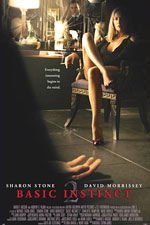
 Basic
Instinct II
SUSPENSE
Basic
Instinct II
How to Wreck a Story
SUSPENSE, 2006
WORTH WATCHING
Starring: Sharron Stone, David Morrisey and David Thewlis; Directed by: Michael Caton-Jones (Rob Roy, Doc Hollywood); Written by: Leora Barsih and Henry Bean.
The ending of this movie wrecked it. While trying to give away as little of the ending as possible let me tell you my complaints because they are annoying to me and are getting more and more common in the industry (they almost deserve some sort of Rant).
FIRST: (with a few exceptions) When you make a movie from the first person perspective you cannot add a "twist" at the end that discredits the first person narrative you just told! When I say "first person narrative" here I do not mean that the camera is looking out of the protagonist's eyes or that there is a first person voice-over. The first person narrative form in movies is generally accomplished merely by setting the movie up so that the story is told through one character. The audience is generally only shown scenes involving that character and only given information that the character knows. To set a story up in this way and then act like it is a "twist" when, at the end of the movie, a bunch of flash-back scenes are thrown in to call into question what the protagonist has been doing is usually a mistake. There are a few films where this works well but generally it is a rip-off as far as story telling goes. The art of story telling involves having the audience buy-into the story. The audience sees character A dealing with whatever hardship are thrown against him or her and goes along with the plot based on the information given through the experiences of that character. To reach the end and find out that the character was performing tasks outside of the view of the audience is cheap and ruins the story. If the audience watches some poor bastard struggle with a mystery only to find out at the end that the bastard was involved in the mastery all along we feel ripped off. Rightly so. There are, of course, movies where it is done and done well but for the most part it is just used to add a "twist" where none was necessary.
SECOND: (and there are no exceptions) Not every freaking movie needs a "twist"! Hollywood is, of course, primarily an economic institution and they are bound to aim at the lowest-common denominator in an attempt to sell a movie to an audience. If audiences appear to like movies with red-balloons, lots of movies will be made with red balloons. Unfortunately for audiences, sometimes this backfires. For example, maybe there are several good movies about red-balloons that do well at the box office. Producers will then start making movies that feature red-balloons without (or so it seems) understanding what it is about red balloons that the audience appreciates. This has happened painfully with "twists". M. Knight Shamala's movies like The Sixth Sense and The Village are great examples of this, as are movies such as The Usual Suspects, Angel Heart, Logan's Run and Reservoir Dogs. What all these movies have in common is that the "twist" is part of the film. It is part of the story. It is part of the reason that the story is told. What they also have in common is that they effectively use a "twist" to heighten the story rather than distract from it. Simply calling into question what the audience has spent roughly two hours watching is not a "twist"; it's a red balloon.
Basic Instinct II is a surprisingly good movie right up to the red balloon dangling in the air at the end. Sharon Stone (getting a little long in the tooth and synthetic-looking in the boob but still hot) is back as the Femme Fatale, Catherine Tremell and this time she is in trouble in London. Accused of murdering a football (that would be soccer) star, Catherine is interviewed by renounced psychologist, Dr. Michael Glass (played by Morrissey). OF course, Dr. Glass becomes obsessed with Tremell and she uses her sexuality and cunning to ensure that he becomes very messed-up indeed. His ex-wife's lover dies and his ex-wife is attacked. Both crimes point to the good doctor but detective Roy Washburn (played by Thewlis) is intent on pinning the deaths where they belong - on Tremell. Unfortunately Washburn is not a very clean cop and Tremell manages to effectively play Dr. Glass against him. As the movie progresses it becomes difficult to tell who actually is committing the murders and whether anyone Dr. Glass has contact with is who they appear to be. The plot moves forward strongly and while I found Stone a little flat, the acting, writing and characterizations are all great. This indeed is a great movie; Right up until the end at which point all is lost. Part of the problem may have been the possibility that the creative minds behind the movie were pressured by the people with money. The director, Michael Caton-Jones has done some good movies but nothing for a while and not a lot in Hollywood. Of the writers, Barish's claim to fame would be the 1985 movie Desperately Seeking Susan and based on Bean's credentials I would label him a talented hack.
The worst part of this movie is that if the powers that be had left it with Tremell walking into the sunset the audience would have been left to speculate about what had actually happened in a very good movie. As it was, with a "twist" (one that I am trying hard not to reveal) at the end, the audience is left to speculate whether it actually was a good movie. I would recommend that you watch this movie and stop watching it when Dr. Glass is lying on the floor screaming. With that as the ending this was an excellent flick. - [July 2006]
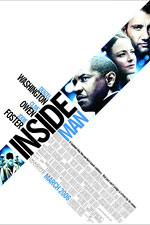 Inside
Man
Suspense, 2006
WORTH WATCHING
Starring: Denzel Washinton (Jodie Foster); Directed by: Spike Lee; Written by: ) and Russell Gewertz and Menno Meyjes (screenplay).
The problem here is that they tried to make two movies. The first movie was about a really cool bank robbery. The second movie was about this detective (Washington) who was having to rough it out in the politics of a big city police department. Either movie could have been great. Both movies together, without letting one take the lead, left each a little flat. Don't get me wrong, this was a highly enjoyable movie, it just didn't go far enough being whatever movie it was trying to be. It felt like it was all sub-plot with no substance. I watched the ending with Spike's commentary with the hopes of getting a better idea of how the characters move onward with their lives. During one scene Spike says that he was asked to do a flashback so that the audience could remember something. Spike felt the audience would remember without the flashback but he stuck the scene in anyway. My god Spike! Who do you think watches your movies? Even with the flashback it was still a bit confusing. In fact, the whole Jodie Foster sub-plot was confusing and fairly irrelevant. It didn't go anywhere. It didn't do anything. Worse yet, some shots (like the bad guys closing the safety deposit box without taking the diamonds) were downright misleading. There is little I dislike more in a movie than purposively misleading shots and dialogue. Overall the pacing could have come up a notch or two and someone should have gone over it with an ambiguity meter. On the other hand, it was beautifully shot, well acted and the bank robbery sub-plot alone is enough to make it a decent flick. - [Aug, 2006].